
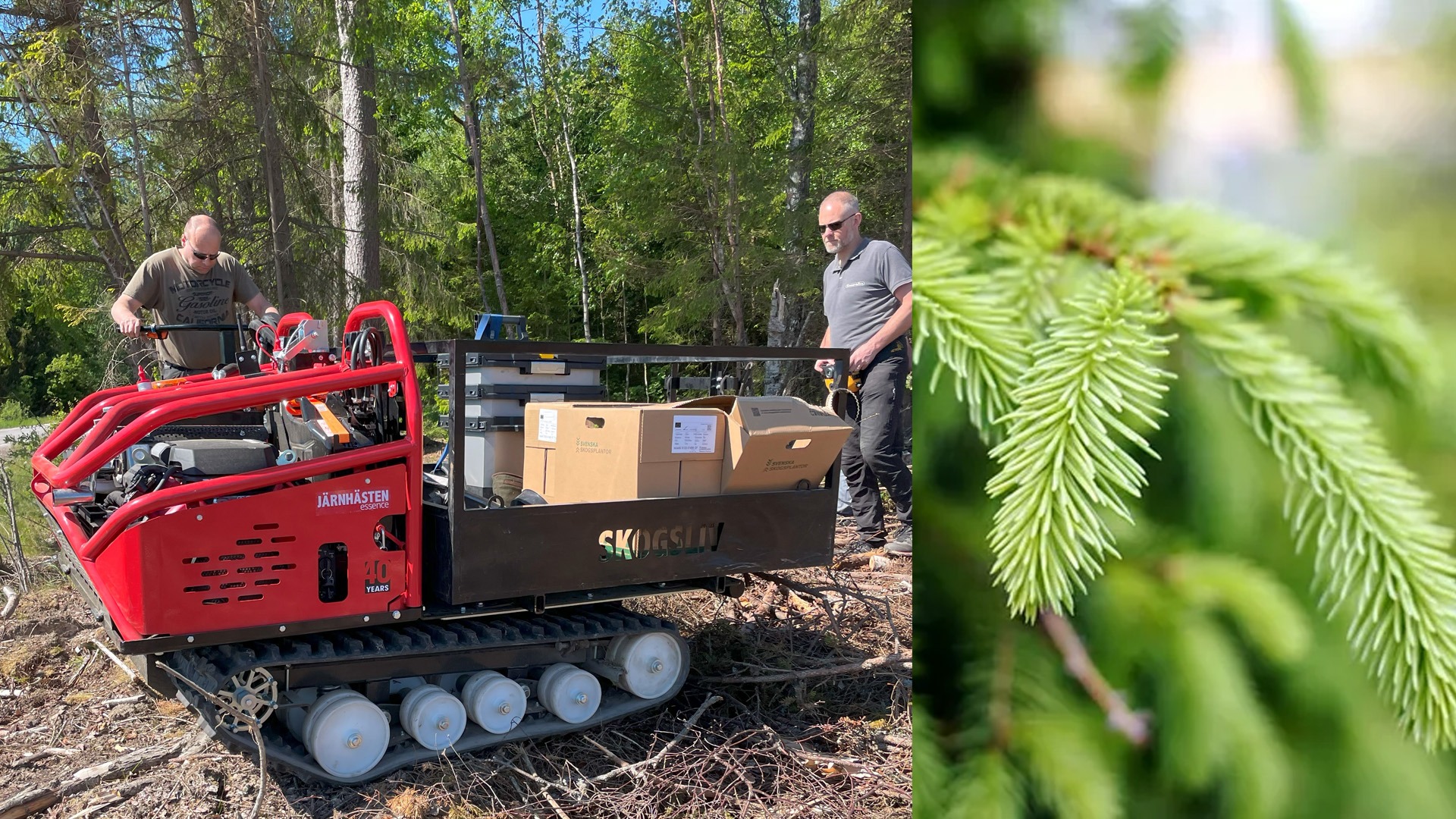
THE FOREST LIFE PROJECT - NOW IT'S TIME FOR "FLEXIBLE SCARIFICATION"
A Test Report from the "Forest Life" project
We are pleased to share the results of the third test in our ongoing series in the "Forest Life" project, where we are developing methods and equipment for efficient and sustainable planting of forest seedlings using the Iron Horse.
Background and purpose
"Skogsliv" is driven by the ambition to improve the conditions for the forest industry, the environment and for people working in the forest. The project is carried out in partnership between Järnhästen/Lennartsfors AB and MOR AB, with the aim of presenting solutions that benefit the entire forest industry and rejuvenation work specifically. The primary target group is forestry companies with professional year-round involvement in forestry work.
The project is divided into three phases:
- Logistics from road to hygge:
- Focused on transportation and handling of staff, plants and vehicles. - Techniques and methods of planting:
- Involved the development of planting methods. - Techniques and methods for land preparation and planting:
- This report.
Objectives and Issues for Stage 3
Stage 3 aims to develop a basis for machinery and methods for an efficient, economic and sustainable combined land preparation and planting process. Specific objectives include:
- Minimal soil impact: No soil damage and less than 5% of the regeneration area affected.
- Increased plant survival: Improved conditions for plant survival through optimal soil preparation.
- Cost-effectiveness and sustainability: low investment and set-up costs and more managed and planned operations.
- Land preparation and planting in the same process: No waiting time between land preparation and planting, reducing costs and facilitating planning.
- More choice: tailoring methods to soil conditions and customer requirements.
Test conditions and methodology
The test was conducted on May 21, 2024 in Frändefors with an Iron Horse Essence equipped with a soil preparation unit. Soil preparation and planting were carried out in direct connection to each other.
The test aimed to evaluate the design, function, method, operation, results, safety aspects and efficiency of the manually operated soil preparation unit on the Iron Horse.
Results and Observations
The results of the tests are divided into several main areas:
Effectiveness
- Set-up time: Approximately 10-15 minutes for unloading and start-up.
- Land preparation and planting: Performed in 20 seconds per point with possible improvement to 12 seconds with two units.
Number of plants planted/hour: Approximately 290 plants/hour.
Evaluation Methodology
- Soil preparation: The method clears the top humus layer and creates planting holes at the same time. Adaptations for better planting were discussed.
- Planting hole: Larger than the plant, which can be improved by design adjustments.
Work environment
- Ergonomics: Easy to pull and place the unit but can get stuck in thick rice. A solution with alternative protection is discussed.
- Safety: A rotating guard over the unit reduces the risk of injury. Improvements were proposed to increase safety.
External Environment
- Environmental impact: Very low soil impact and low fuel consumption. The test met the target of impacting less than 5% of the surface.
Economy
- Moving costs: Using a car and trailer for transportation is efficient. Tipper trailers are recommended.
- Investment costs: A radio-controlled Iron Horse with two soil preparation units and a plant bed costs about SEK 450,000, which is economical compared to larger machines.
Summary of results
The tests show that with new technologies and simple means it is possible to:
- Cost-effective land preparation and planting in the same process.
- Offer greater choice in rejuvenation efforts.
- Carry out soil preparation on smaller land areas.
Further development work and tests will focus on improving the design of the soil preparation unit and developing a digital documentation system.
For further information, please contact:
Mikael Swartz, CEO, Järnhästen, 0046 573 392 27
Hans Grevelius, Foreman, MOR, 0046 707-68 30 00
Skogsliv continues to explore practical solutions that benefit the forest industry, particularly in regeneration work, while complying with upcoming environmental regulations and adapting to trends such as limited harvest sizes and growing interest in no-felling forestry.
Want to know more?
If you want to know more about the project and how you can already use transport solutions with the Iron Horse, contact our product manager Peter Rodin.
With the Forest Life project, we aim to revolutionize forestry by optimizing logistics and working conditions. With a focus onefficiency and sustainability, the project explores innovative solutions in planting logistics and forest worker conditions through practical tests and collaborations to meet the growing needs of the industry and the environment.
The solutions already developed, and new innovations in the project, are characterized by simplicity and practicality.